Well, the summer's half gone and I haven't accomplished one quarter of my goals. The hallway wall paper is finished (thanks, Gillie!) although the staircase still needs doing. The Pennsic A&S stuff is nearly finished--the book of classes went to press, but there are always additional classes left to schedule and the webpages need updating daily with changes as teachers cancel, add more classes, want to switch days/times.
On the other hand I have been able to do a lot of reading. . . .
For you murder mystery fans I suggest checking out the Magdalene la Bâtarde series by Roberta Gellis. there are three volumes which should be read in order: A Mortal Bane, A Personal Devil, and Bone of Contention. Magdalene is the whoremistress of the Old Priory Guesthouse in Southwark--which is what first caught my attention when I read the publisher's blurb.
I once took a remarkable walking tour of the high points of Shakespearean London (including a death-defying stroll along a not-really-public-access walkway on the Blackfriars bridge underpass) with William P. Williams; and when we reached Southwark, William told us the story of the Bishop's Geese.
It seems that the Bishops of Winchester have always lived in Southwark (pronounced sooth-ark) in close proximity to the Cathedral there. And because of the laws against theaters in London, the theaters (the Globe, the Rose, the Curtain) were built outside of the city walls--many in Southwark. Well, theaters tend to attract crowds, and crowds tend to attract sellers of all sorts of merchandise. One of the most popular things a theatergoer in Medieval times might be able to pick up in Southwark was a "lady of the evening." And since it made sense for such ladies to have "rooms" nearby, and since Medieval bishops tended to be wealthy and own properties, the bishops of Southwark became the landlords of many medieval to early modern brothels (note that I said landlords, not pimps, though I must point out that the distinction is rather unclear historically). The upshot of the story is that the prostitutes of Southwark were many and often under the protection of the bishops, but you don't say things like that out loud--so the euphemism for prositutes soon became "the Bishop's Geese."
Now you see why a murder mystery set in the 12th century where the mysteries are soved by a very uncommon lady who runs a very uncommon guest house under the protection of the bishop of Winchester sounds interesting to me?
Am I going to review this book; give you the 50 cent synopsis? Nah. You'll have to read it for yourself. I'll just say that if you liked Brother Cadfael or Sister Fidelma or Dame Frevisse, you'll love Magdalene la Bâtarde! Gellis has done her research on the period, and yet manages to push the feminist envelope with her treatment of the gender issues all the while telling a darn good story with characters you can care about. I picked up the first book on Saturday, went back for the next two on Sunday--simply devoured them and can't wait for the next one in the series.
Showing posts with label books. Show all posts
Showing posts with label books. Show all posts
21 January 2014


If it is Tuesday this must be AEthelmearc
Today has been rainy off and on. No thunderstorms (as were predicted), but hot and damp. I worked at Water Point all morning. So damp and even damper.
The bitching this war is all about the book. No day by day schedule. I told Frog, next years Pennsic Mayor, I'd do Cultural Affairs next war, and I promise a day by day hour by hour schedule. For PW 39 I am back to running Info Services. So any of you reading this... If you want a job... Email me!
Tonight is AEthelmearc court. Daedez, our much beloved Khan, will be getting her laurel for Mongolian research. Party afterwards. I have about 10 dozen Chinese dumplings in my cooler to fry for the party. And 4 dozen stuffed grape leaves as well. The Ansteorran brothers are doing the "big hunk of meat" on a grill thing. Much wine. Emma's made the infamous cheeseball. Good times will be had by all.
Stay tuned for pictures!
The bitching this war is all about the book. No day by day schedule. I told Frog, next years Pennsic Mayor, I'd do Cultural Affairs next war, and I promise a day by day hour by hour schedule. For PW 39 I am back to running Info Services. So any of you reading this... If you want a job... Email me!
Tonight is AEthelmearc court. Daedez, our much beloved Khan, will be getting her laurel for Mongolian research. Party afterwards. I have about 10 dozen Chinese dumplings in my cooler to fry for the party. And 4 dozen stuffed grape leaves as well. The Ansteorran brothers are doing the "big hunk of meat" on a grill thing. Much wine. Emma's made the infamous cheeseball. Good times will be had by all.
Stay tuned for pictures!
in the wee hours
Long day today. Here it is nearly 2 am and I am still sitting here waiting for a class confirmation email before I shut down for the night and get some sleep. Been scheduling classes for Pennsic all day (807 now and counting) and I think my brain is simply overloaded. Cass and Zsof and Elizabeth were all here today to help work on and proofread the Pennsic book. . . and we get to start again at 9am tomorrow. I seem to be double booking my hours now as well as my days. So much to do--so little time. . . Haven't seen Silver half enough! Lisa and Michelle stopped by after dinner when I just couldn't get up the energy to work on the book any more--and we sat on the porch drinking wine coolers and listening to the rain. I need more of that in my life. But then don't we all.
31 March 2011
Framing Innocence Author to Speak at CWRU March 31
Framing Innocence Author to Speak at CWRU March 31

Lynn Powell
Oberlin author Lynn Powell turned to nonfiction for her latest work, Framing Innocence. The book tells the story of Oberlin resident Cynthia Stewart, who fought for her innocence after being accused of taking obscene photographs of her daughter Nora, 8, bathing.
Powell will read from her book, published last fall, during a reading and discussion sponsored by the Department of English and the Baker-Nord Center for the Humanities. The free, public event will take place at 4:30 p.m. Thursday, March 31 in the Guilford House parlor.
Stewart’s story made national headlines in 1999 as the mother, who had taken photographs throughout her daughter’s life, became embroiled in a battle with Lorain County’s legal system. The photographs came to the attention of the police when a Discount Drug Mart employee alerted police to four bathtub images among 11 rolls of film submitted for processing.
Powell chronicles how Oberlin’s residents rallied to support Stewart in her struggle by providing a host of free services to help the family through its struggles. She will elaborate on her methods of research and reporting the story.
Stewart’s plight raises issues of privacy, the psychology and dynamics of the family, first amendment rights, the troubling nature of the “male gaze” and the struggles of an individual vs. the legal bureaucracy, said Mary Grimm, chair of the English department.
For information, email Susan Grimm at sxd290@case.edu.
14 March 2011

04 January 2011
Time to Write?
You know that saying about how you have to make time to have time? Whoever said was full of s***. Whoever said that never had jobs like mine. I do 20 hours a week program administrative stuff that often turns into more hours and even weekend hours. Four classes a semester that have three different preps. Not that I am bitching (well, okay I am whining a bit), because I do love my work. I really do. I have a great Program Director for the NEOMFA, and I like the classes I teach: non-western literature, Chinese history, and this last semester a new one "Humanities in the Western Tradition" (think history of the western world from ancient Mesopotamia to Renaissance Europe).
But between herding the MFA cats (and I am not just talking students here), and lecture prep, and grading. I have not written anything worthwhile since July. Random snippets of poems, nothing solid. Sometimes when I haven't been writing in a while it feels like the words just go round and round in my head until it wants to explode. It helps to have friends an family to talk to about the ideas you have, but sooner or later you have to put them down on paper. Writing is how I process things. It's cathartic. The only other thing that works that way for me is reading.
Happily I just spent my last week of Winter Break reading a huge stack of books. You want to know what you should check my list on Good Reads. The only writing I will be doing soon is my syllabi for the Spring semester. Oh, for Spring Break and the next stack of books.
But between herding the MFA cats (and I am not just talking students here), and lecture prep, and grading. I have not written anything worthwhile since July. Random snippets of poems, nothing solid. Sometimes when I haven't been writing in a while it feels like the words just go round and round in my head until it wants to explode. It helps to have friends an family to talk to about the ideas you have, but sooner or later you have to put them down on paper. Writing is how I process things. It's cathartic. The only other thing that works that way for me is reading.
Happily I just spent my last week of Winter Break reading a huge stack of books. You want to know what you should check my list on Good Reads. The only writing I will be doing soon is my syllabi for the Spring semester. Oh, for Spring Break and the next stack of books.
05 December 2010
Things you think about when you can't sleep
It's 4 am on a Sunday morning when I could be asleep, but since I am not... Funny how the brain works. I wake up a lot in the early morning hours, 3am, 4am; then I just lay there in bed thinking. I used to get up and write (poetry, stories, blog posts), but I haven't been writing much at all since early last summer. Not that I don't have anything to write about. In fact the opposite is more true. I have far too much to write about... so much in my head I just don't really know where to begin and (this may sound odd) on top of that I don't know anymore who I am writing for.
One of my fiction writer friends says she writes because she has to. If she didn't the words, the ideas, would just keep rolling around in her brain and drive her crazy. I can understand that. Sometimes I wish my brain had a switch--on, off, clear cache... reboot.
Somehow, though, for me writing has to have an audience. And therein lies the rub. If I write about most of the stuff in my head anywhere I send it, post it, or share it, it is bound to offend someone. The thing about stories is that they want to be told. They don't want to sit in notebooks or lie about in drawers. So I feel compelled to publish, to share. My biggest problem is I am not good at audience. Although half my audience is generally chuckling and enjoying the story immensely, the other half is invariably bored, or worse: pissed off.
One of the first poems I ever published was about my grandmothers, my mother, and my daughters. I was looking at how women carry on through generations. My mother's only comment was about the stanzas she was in, and what she said to me was: "That's a lie, it didn't happen that way."
What I had been telling was her story as I had heard it, from her, from my dad, from others. Filtered through my writer's sensibilities and my (imperfect? biased?) observations of her as her daughter. What she saw in herself was so different that she was angry at my less than flattering portrait. But the woman she saw herself as could be seen only through her filters. Two different stories. Both accurate if disparate views. My story was about an ordinary woman with with extraordinary desires leading an ordinary life. The problem is no one wants to be seen as ordinary. Not really. Certainly not my mother, who spent most of my childhood telling us how happy we were and how lucky we were to be us--this ideal suburban family. What I still see looking back is a husband who got drunk, ran around looking to other women for affection he didn't get at home, because he never made enough money to support five kids or to satisfy a woman who had her dreams of movie-stardom thwarted by the realities of motherhood and the embarrassment of dependence on her own mother for handouts and hand-me-downs. When I tell the story my way I upset my family. When I tell the story the wasy they want it to be seen, it's not as good a story.
In some ways there are beautiful stories in there, in my head. The problem is my characters don't ever look heroic when seen by those who inspired them. Especially when inspired by people I care about most.
Right now I have the urge to write about my daughters. But I know if I do I will anger at least one of them, confuse one of them, and amused the third. Do I dare that chance that they will or will not see my fiction for fiction?
One of my fiction writer friends says she writes because she has to. If she didn't the words, the ideas, would just keep rolling around in her brain and drive her crazy. I can understand that. Sometimes I wish my brain had a switch--on, off, clear cache... reboot.
Somehow, though, for me writing has to have an audience. And therein lies the rub. If I write about most of the stuff in my head anywhere I send it, post it, or share it, it is bound to offend someone. The thing about stories is that they want to be told. They don't want to sit in notebooks or lie about in drawers. So I feel compelled to publish, to share. My biggest problem is I am not good at audience. Although half my audience is generally chuckling and enjoying the story immensely, the other half is invariably bored, or worse: pissed off.
One of the first poems I ever published was about my grandmothers, my mother, and my daughters. I was looking at how women carry on through generations. My mother's only comment was about the stanzas she was in, and what she said to me was: "That's a lie, it didn't happen that way."
What I had been telling was her story as I had heard it, from her, from my dad, from others. Filtered through my writer's sensibilities and my (imperfect? biased?) observations of her as her daughter. What she saw in herself was so different that she was angry at my less than flattering portrait. But the woman she saw herself as could be seen only through her filters. Two different stories. Both accurate if disparate views. My story was about an ordinary woman with with extraordinary desires leading an ordinary life. The problem is no one wants to be seen as ordinary. Not really. Certainly not my mother, who spent most of my childhood telling us how happy we were and how lucky we were to be us--this ideal suburban family. What I still see looking back is a husband who got drunk, ran around looking to other women for affection he didn't get at home, because he never made enough money to support five kids or to satisfy a woman who had her dreams of movie-stardom thwarted by the realities of motherhood and the embarrassment of dependence on her own mother for handouts and hand-me-downs. When I tell the story my way I upset my family. When I tell the story the wasy they want it to be seen, it's not as good a story.
In some ways there are beautiful stories in there, in my head. The problem is my characters don't ever look heroic when seen by those who inspired them. Especially when inspired by people I care about most.
Right now I have the urge to write about my daughters. But I know if I do I will anger at least one of them, confuse one of them, and amused the third. Do I dare that chance that they will or will not see my fiction for fiction?
25 August 2010
Websites and Facebook and Wikis, Oh my!
The NEOMFA is in the process of getting a new website. For the last 3 years. No. Really. Partly it's that the people involved don't seem work or even all talk to each other until someone nudges them. Our first web designer at KSU fell off the planet with the project. The current web design team is fine. Comes up with lovely graphic (all very steampunk and industrial) which bodes well for the new NEOMFA "Rustbelt" look. But they don't doe HTML so we need a web tech to put the pages together. Enter UA webteam. But the pages are currently at YSU. And their webteam and helpdesk can't seem to agree on how to get me access to the pages. So we have more temporary pages. Sigh.
The today I came across this xkcd comic with sums up my feelings as I tried to navigate the webpages of four universities and find the info, forms and deadlines, needed by our upcoming candidates for graduation.

At the same time there are the ongoing Twitter and Facebook pages to update. If I post to Facebook it drops into Twitter, but not the reverse (or you end up with a nasty loop of continuous back and forth reposing of the same message!). File that under "things we learned the hard way."
One way cool thing to stay tuned for is the (in process) NEOMFA wiki page that is currently being created by our oh-so-savvy NEOMFA GA, Shurice.
The today I came across this xkcd comic with sums up my feelings as I tried to navigate the webpages of four universities and find the info, forms and deadlines, needed by our upcoming candidates for graduation.

At the same time there are the ongoing Twitter and Facebook pages to update. If I post to Facebook it drops into Twitter, but not the reverse (or you end up with a nasty loop of continuous back and forth reposing of the same message!). File that under "things we learned the hard way."
One way cool thing to stay tuned for is the (in process) NEOMFA wiki page that is currently being created by our oh-so-savvy NEOMFA GA, Shurice.
12 July 2010
I Can Haz Dragon
So it’s 3-something in the morning and I can’t sleep and after wandering aimlessly around the internet my Google feed reader points me to SFFN and The Dragon Diaries: Part the Third. Now I am ROTFLMAO and know that, with visions of dragon happy-meals dancing through my head, I likely won’t sleep anymore tonight. (Have you ever tasted a mime? Not funny. Did you know that if you eat a unicorn you could get sparkly rainbow indigestion and glitter farts? How do you shuck a knight anyway?)
The Dragon Diaries is a whim of author Kelly McCullough who, in delightful twitter-sized tidbits gives us a peek into the mind of an adolescent dragon (a la cheezburger).
You will discover the life of a dragon is sometimes fun: Met a knight-at-arms, alone and palely loitering. Ated him. Ated pretty lady he kept whining about too. Hard and cold on the outside, but soft and warm on the inside. Yummy! Thinking of lounging on my hoard today. Dragons are supposed to do that sometimes, aren’t they? And Nap + Sparklys = Win!
And sometimes difficult: Saw the pointy-face horse again today. Still looks delicious. Want! Maybe cat is wrong about obsession being unhealthy… Just realized that pointy-face horse is kind of Sparkly… Sparkly! Sparkly! Sparkly! Sadness. Sticking fake horn on normal horse doesn’t make it sparkly. Doesn’t improve flavor either. Ated horse anyway.
Then there is the ubiquitous dragon wisdom: Am entertaining job offer from Fafnir, Fafnir, Tiamat & Lung, dragons at law. They tell me it’s mostly just about ateding opposing counsel. Mmmm, lawyers.
And the ever so much more accurate cat wisdom: Cat talked me out of ateding polling station, says ateding should be reserved for actual polti… polict… polst… elected people.
I now have visions of the dragon being let lose in Washington, DC. I have a little list I want to share with the dragon. And I am reevaluating the advice my cats give me. Think I'll go find some sparklys for my pillow now and see if I sleep better, maybe dream of dragons. Thanks, Kelly.
Kelly sez: For an explanation of how this got started, the original Dragon Diaries SFN post is here. The second DD post is here. To find out where it goes, you can watch the experiment continue on twitterand facebook for however long it continues.
24 June 2010
When does Fiction cross the line?
It's a TV series about a doctor, or a bunch of cops and lawyers. You know it's fiction. Yet I can't tell you how many times someone has said, "Oh, I saw that on [insert show of choice here]" and proceeded to tell me some "fact" they now know about medicine or the law.
This conflation of fact and fiction is nothing new. The stories he made up of King Arthur were "chronicled" as history by Geoffrey of Monmouth in the 12th century. A popular (fictional!) mystery series today features the (real!) 19th century author Jane Austen as a solver of murder mysteries. I could go on and on.
This conflation of fact and fiction is nothing new. The stories he made up of King Arthur were "chronicled" as history by Geoffrey of Monmouth in the 12th century. A popular (fictional!) mystery series today features the (real!) 19th century author Jane Austen as a solver of murder mysteries. I could go on and on.
So when the real and larger-than-life-damn-near-American-institution poet Walt Whitman becomes a fictional character in the breakout novel by Canadian author and poet George Fetherling, no big deal right? Or is it?
From Charles Demers' interview of Fetherling in the Vancouver Straight.com online news we hear that Featherling is not a Whitman fan:
“I don’t like Walt Whitman,” Fetherling explains over lunch on Denman Street, just a few blocks from his beloved Sylvia Hotel. “His ideas have killed more people than malaria.…He was practically one of the fathers of Americanism qua-ism." Later on in our conversation, Fetherling posits that Whitman “would be a Fox [News] commentator if he were alive today”. There aren’t too many gay 19th-century poets you can say that about.
Here's the rub. In Fetherling's novel the Whitman character's gay lover is part of the plot to assassinate Lincoln. So line it up. American poet. Civil War record as a nurse, civil servant. Heroic sounding, no? And he wrote this Leaves of Grass thing, defining America, right? Iconic, right? So does Fetherling's portrayal of Whitman tarnish, as one respondent says, a great man's reputation?
Fetherling has published a book about Walt Whitman that the reviewer describes as “a plot-driven potboiler about the Lincoln assassination…”
At the heart of Fetherling’s novel Walt Whitman’s Secret, we learn that Whitman’s friend and lover Peter Doyle was a co-conspirator with [John Wilkes] Booth, the man who murdered Abraham Lincoln, that Whitman knew of the plot beforehand, and that he did nothing to alert the police, merely advising his friend to cut ties with the plotters.
It’s a very terrible, very ugly allegation, because it places Whitman close to being an accomplice, and because it brings into question the moral foundation of Whitman’s being.
Has Fetherling proof? I asked him this at the Vancouver launch of his book, and he said no. He went on to claim that as he is writing fiction, he is not required to prove anything; moreover, the law of defamation no longer applies, given that Whitman died in 1892.
I am not talking law, but ethics.
> Richard Harvey / North Vancouver
Is it fair to Whitman? This is a work of fiction. Not to be taken too seriously, right? But also by Demer's account, a potentially great novel, so one that might be taken very seriously:
But the bulk of the novel is a quiet, deliberate, beautifully wrought meditation on two things: on the one hand, the life devoted to literature and its attendant hustles; on the other, the uneasy relationships between the United States, the Confederacy, and Canada.
As a work of postmodern fiction this is makes an excellent plot device. But there are a number of interesting questions that a work like this raises. What does a writer of fiction owe to the historical truth? Is there any historical truth at work here, anyway? Should we even ask a question like that of a work of fiction? Can this fiction tarnish the truth of Whitman's life? Post mortem does it even matter? How gullible are Americans anyway?
Sadly, it is that last question that worries me the most.
Still, I am looking forward to reading Featherling's book. To be honest I am not that fond of Whitman either, but that is not why. I want to use both Whitman's work and Fetherling's novel side by side in a class I sometimes teach: Classic and Contemporary Literature. Because if this isn't an example of the classic influencing the contemporary I don't know what is.
11 June 2010
Another spring is rapidly coming to an end . . .
. . . and I have been slower than usual about blogging. Again.
No surprise really. I have had a less-than-wonderful 2010 so far. Broken left knee. The discovery that I am allergic to my long-term asthma medications (and the accompanying icky red rash on my face from them). Car broken into and backpack with laptop and accessories stolen (value totalling $2500+ of which insurance only covered $900. Top that with the lovely tax day discovery that I owed the IRS $3000+. So, yeah. Not a stellar spring.
 On the other hand, the need to strengthen the knee led me to doing more bicycling--got out the old bike to refurbish and found that it was less expensive to buy a new one. So one brand-new retro bike later (which incidently reminds me of my childhood) and I'm on the road. I still say I need pink plastic handle tassels and a wicker basket. Maybe even a little bell.
No surprise really. I have had a less-than-wonderful 2010 so far. Broken left knee. The discovery that I am allergic to my long-term asthma medications (and the accompanying icky red rash on my face from them). Car broken into and backpack with laptop and accessories stolen (value totalling $2500+ of which insurance only covered $900. Top that with the lovely tax day discovery that I owed the IRS $3000+. So, yeah. Not a stellar spring.
 On the other hand, the need to strengthen the knee led me to doing more bicycling--got out the old bike to refurbish and found that it was less expensive to buy a new one. So one brand-new retro bike later (which incidently reminds me of my childhood) and I'm on the road. I still say I need pink plastic handle tassels and a wicker basket. Maybe even a little bell.
 Of course although I am having a ball with it and cycling like a mad woman between my home and Angel Falls for coffee, and to the library for books, I have already taken my first spill and ripped up my right knee. Good news is Steve made me buy and wear a helmet. Bad news is I tore my best black jeans and it hurts. Good news is I am limping evenly now that both knees are boo-booed. Bad news is the left knee is still swelling a lot at night, good news is that the road rash is is tender enough that it distracts me from other annoyances. And it all is healing, albeit slowly. Getting older sucks.
 On the family news, my grandchildren are all walking now. Juliette here is 11 months. I haven't met her yet and won't until the end of summer--can hardly wait.
 Chloe (1 year) and Liam (four years) are as adorable as ever. Happily they will be nearer after July when they move to WI from AZ. I hope to see more of them once in the midwest.
And Emelie is her usual precocious 2 year-old self--Disney princess that she is.
So in many ways the glass is both half empty and half full.
Guess we will see what summer brings.
07 March 2010
08 February 2010
A Quote for February, and for Lovers
"The terrible thing about love is that it takes away your safety net, your balancing pole. Even the tightrope you walk upon will disappear beneath you, yet love expects you to keep walking anyway, arms outstretched, one foot after the other, on nothing more than air."
— Christopher Barzak, from The Love We Share Without Knowing
— Christopher Barzak, from The Love We Share Without Knowing
07 February 2010
How Social Gaming is Improving Education
In an article by Greg Ferenstein on Mashable.com, we are told that:
Audits of the U.S. educational system have revealed that the highest hurdle to adopting skills-based teaching practices is the lack of an easily implementable curriculum.
Enter social video games as a solution — immersive environments that simulate real-world problems. Today, technologically eager schools are replacing textbook learning with social video games, and improving learning outcomes in the process. Here’s how they’re doing it: How Social Gaming is Improving Education
Especially interesting to me, personally, is the use of the virtual world Second Life as part of the curriculum where hands on training and role play can teach a critical skill set, as in this example Ferenstein mentions:
Loyalist College in Canada recently boasted “massive” test score improvements for its border officer training via simulation in the virtual world of Second Life. “No single technological addition has ever impacted grades at the college in such a positive way,” says Ken Hudson, their Managing Director of Virtual World Design. Indeed, the results speak for themselves. According to the report:
“The amazing results of the training and simulation program have led to significantly improved grades on students’ critical skills tests, taking scores from a 56% success in 2007, to 95% at the end of 2008 after the simulation was instituted.”
Audits of the U.S. educational system have revealed that the highest hurdle to adopting skills-based teaching practices is the lack of an easily implementable curriculum.
Enter social video games as a solution — immersive environments that simulate real-world problems. Today, technologically eager schools are replacing textbook learning with social video games, and improving learning outcomes in the process. Here’s how they’re doing it: How Social Gaming is Improving Education
Especially interesting to me, personally, is the use of the virtual world Second Life as part of the curriculum where hands on training and role play can teach a critical skill set, as in this example Ferenstein mentions:
Loyalist College in Canada recently boasted “massive” test score improvements for its border officer training via simulation in the virtual world of Second Life. “No single technological addition has ever impacted grades at the college in such a positive way,” says Ken Hudson, their Managing Director of Virtual World Design. Indeed, the results speak for themselves. According to the report:
“The amazing results of the training and simulation program have led to significantly improved grades on students’ critical skills tests, taking scores from a 56% success in 2007, to 95% at the end of 2008 after the simulation was instituted.”
In another example, 6th graders learn geography from Google Earth, collaborate through an internal social networking platform, and present ideas through a podcast. Administrators hope that wrestling with the question of “How can a system function within a larger system?” will bolster critical thinking skills. Many experts contend that so-called “Scaffolded Problem-based learning” is known to improve academic skills and enhance motivation. With all these new toys, it’s no surprise that one student admits his least favorite part of the day is “dismissal.”
Having used social networking (Facebook, Twitter, Blogger), 3d technology (Second Life, Google Earth), as well as online texts (Project Gutenberg, NetLibrary, JSTOR and other online databases) and media (YouTube, TeacherTube, Ohiolink Digital Media, Hulu) in my classrooms, my personal take is that anything that enhances the learning experience, keeps the student's attention, and gives students tools they will need in the real world, is a plus! There is no reason to suppose that just because it is fun, technology can't also be eductional. As Ferenstein says:
Social gaming has a come a long way from the days when a dozen students would squint at a 10-inch screen of Oregon Trail. The 2000s seemed to be the decade of case studies: Bold educators willing to experiment with developing technologies. But now, the involvement of major funders, such as the Bill and Melinda Gates Foundation, points to an industry that is on the cusp of freeing education from its 2D textbook prison.
Social gaming has a come a long way from the days when a dozen students would squint at a 10-inch screen of Oregon Trail. The 2000s seemed to be the decade of case studies: Bold educators willing to experiment with developing technologies. But now, the involvement of major funders, such as the Bill and Melinda Gates Foundation, points to an industry that is on the cusp of freeing education from its 2D textbook prison.
23 January 2010
Home Renovations or why I have no life anymore
I have been in a very creative mood of late. Did a copper ceiling tile backsplash (ok, faux-copper, really plastic) in the kitchen 2 weekends ago. This weekend the upstairs bathroom was on the list. 
Just finished the third base coat of Venetian plaster on the lower half of the bathroom walls. It was a good way to deal with damaged plaster and old brick-scored plaster without having to rip it all out. I have decided I am am liking the blue. I was going to go for a terracotta color at first, but Steve liked the blue green. Now I need to apply the topcoat/sealer, which will deepen the color and bring out green highlights (or so the pictures on the instructions tell me). 
Next it's paint the woodwork, finish stripping the floor, finish up this pine floor (refinish? paint a faux rug? tile?). After that I need to decide what to do about the stupid pipes that run across the floor behind the toilet that are left from the days when this was a multi-apartment house (take 'em out? sink "em into the floor? or paint 'em bright copper, add mechanical bits, and call it steampunk?). Steve sandblasted the heat vent cover at work this week and, lo, it was white brass underneath! I think I am just going to clear coat the hell out of it because I love the weird copper streaks that showed from where the brass is thin. I guess back in 1918 brass-plated copper was the deal.
Of course, the vanity for the sink in here has got to go--I have this old dresser that I want to polyurethane within an inch of its life, then add a glass bowl and faucets to convert it into a sink. But that is a project for another weekend--after painting and floors. And after painting the downstairs powder room. And adding bookshelves to the third floor library. And tearing up the nasty kitchen floor.
Also after grading papers (yes, already, even this early in the semester), and getting my book revamped to send to another press for further rejection, and... and... and... You get the drift.
06 January 2010
The Graveyard Book: be afraid of live people...really!
Stumbled on this today as I was preparing my syllabi for Spring semester. And since I am using The Graveyard Book in my Fiction Appreciation class I thought I would post the clip of Neil Gaiman's interview with Stephen Colbert here for my students and all of you to enjoy.
And if you haven't read Neil's books . . . what the hell is wrong with you?
| The Colbert Report | Mon - Thurs 11:30pm / 10:30c | |||
| Neil Gaiman | ||||
| ||||
And if you haven't read Neil's books . . . what the hell is wrong with you?
18 December 2009
Talking to Australia
This morning I was on Skype with my daughter in Perth. 9 am my time is 8 pm hers. So she was playing with Juliette, my new granddaughter, just before bedtime. The baby was rolling about on the bed and squealing, while gramma and mom had serious girl talk about nappies (diapers), playing in the spa (hot tub), and what baby did all arvo.

While online I used Jing to do some screen capture photos and to video my baby girl's baby girl at play.
This is the thing I love about the brave new world we live in: I am in touch with everyone all the time! My daughter in OH posts her daughter's adventures on her blog. My daughter in DC texts me and chats with me regularly in gtalk. With Skype I get to webcam with my son, grandson and granddaughter in AZ as well as my daughter and her family in Australia. We all make phone calls, of course, but now I can see them all as well as hear my children's voices. And then there is the blogging and facebooking and tweeting we do back and forth, updating each other on a daily (sometimes hourly!) basis.
Just 20 years ago my parents had to wait until a holiday to see their grandchildren, my children, because we lived several states apart. Going overseas meant being out of touch until you got home because phone calls were too expensive except in emergency. Even long distance calling was kept to a minimum because of phone bills and rates. The internet has changed the nature of communication and that is a marvelous thing. Why just this morning I got friended in Facebook by my cousin in TX with whom I only recently reconnected.
Today, thanks to the technology of Twitter, Facebook, blogs, Skype, and the many Google marvels like gtalk, gtalk video, and wave. I can be in touch with multiple friends and colleagues. My tweets spill into my gtalk and FB statuses. My blog posts show up on my FB wall. There are people who say we share to much information. Me, I like the idea of a transparent society. I love this techno-geek shit!
17 December 2009
April is National Poetry Month
Yes, I know it isn't April yet. But this morning I got an email that the posters are coming soon. The Academy of American Poets (at Poets.org) puts out a great poster celebrating poetry every year well before April. Here's how you get one for yourself:
Free National Poetry Month posters are available by request—while supplies last—to teachers, librarians, and booksellers. Submit your request now to receive the poster in time for April 2010. Sign up > But don't wait until April to celebrate poetry! The other thing you can do right now is participate in the Free Verse Project. This is a very cool way to mashup poetry and photography. First check out some of the cool photos in the Poets.org Flickr group like the one below which was chosen to be last years AAP Poetry month poster! 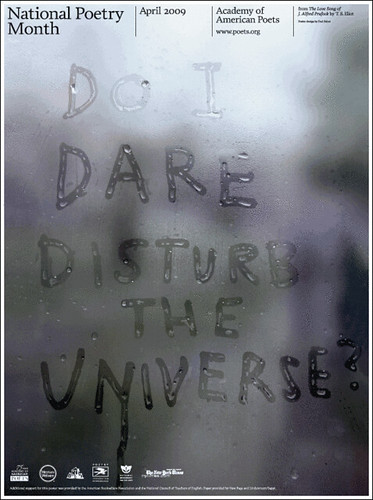 Watch the whole slideshow here! Then go out and create your own poetry and graphic mashup! Post it on your Flickr page and submit it to the group. Who knows, maybe you will be chosen for the next April is Poetry Month poster! Watch the whole slideshow here! Then go out and create your own poetry and graphic mashup! Post it on your Flickr page and submit it to the group. Who knows, maybe you will be chosen for the next April is Poetry Month poster! |


17 November 2009
Twitter Stats
The internet constantly amazes me. I have been Twittering for a while now. It links to my Facebook page and updates my status. I find people I haven't seen in ages and get back in touch. I follow my favorite writers and talk to them. And I see who follows me and reads what I write with Google Analytics. Now a very nice fellow, Damon Cortesi, has put up pages where you can track the stats (gratis even, though if you can throw money his way that would be nice too!) on your twitterings. These are my stats.
And here is my Tweet cloud--everyone I talk to and everything I talk about:
akron @amandapalmer amen angel available bancroft @barackobama birthdayblackberry blog blogger book budget cable car @cbarzak cbs china chinese class classic @colinmeloy comecomputers contemporary coraline costume crackberry cup @danchaon date day december desktop did didnt digitaldiscovered disney @dkjpusa dollhouse driving edu eggs facebook fans fb featured feeling fend finding flu fm fungoing good google @hadesarrow halloween haroun hes issue join @joshwhedon kelly king knock know kokosleave let lets life lit little @lkhamilton long look loop lots love m74kpv make meetings mercedes mixed monkeymorning need needed neil @neilhimself new news nose @nytimes office oh ohio oplin org pakistaniaatpics procrastinating psychic ramadan read reading really reimbursed rest @robertleebrewer rt sad say schedule@shannon_anicas shout sigh signing sista smart springboard start status story students sunday tales thats thinkthinking thought today touch transformed_ tweetstats twitter twittering uakron uber unfollowing university viigovirtualit want way week weekend weekends went @whedonfannews woman women work www yeah yes yr
Cool, No? I love technology.
Subscribe to:
Posts (Atom)